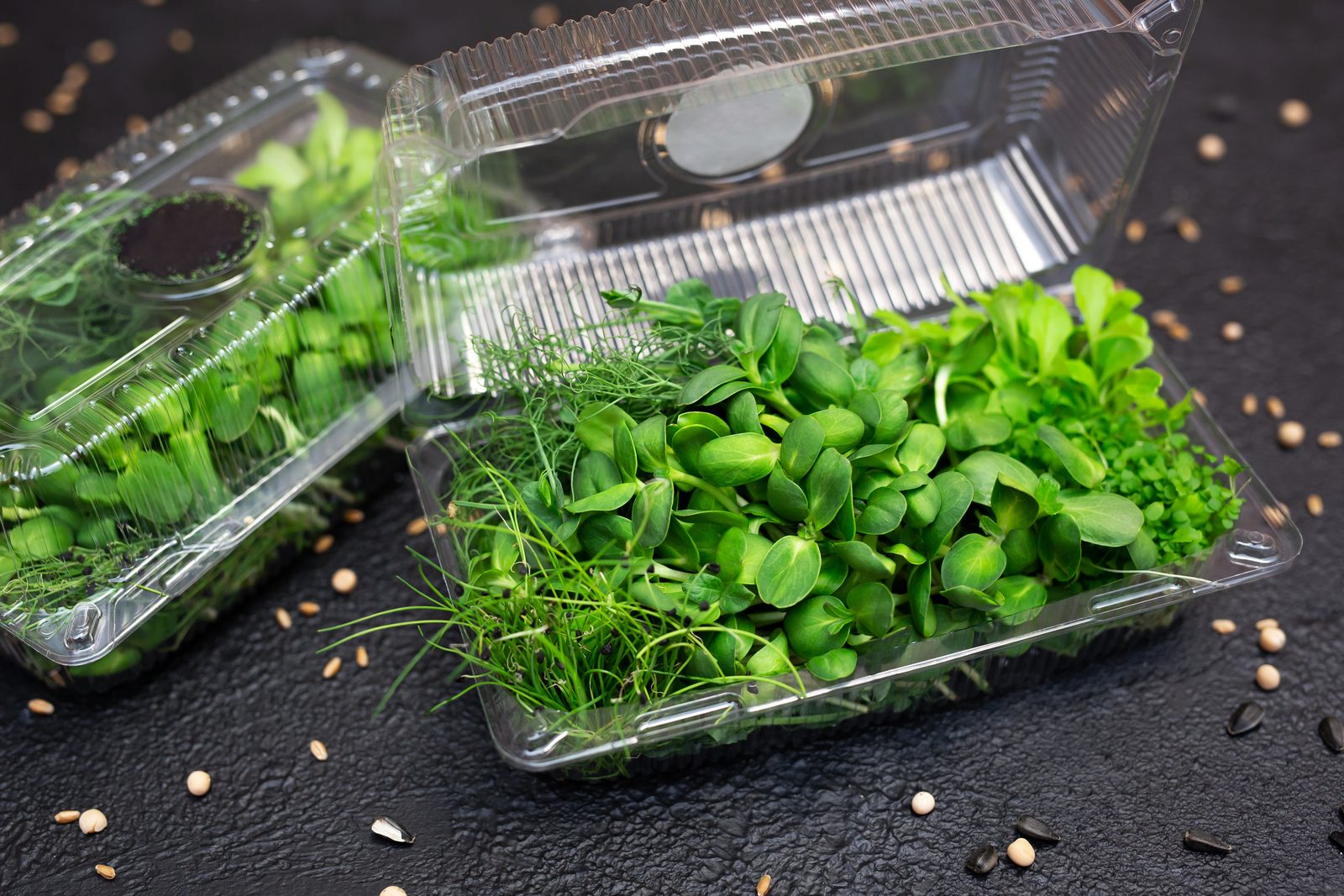
I bought a clamshell of microgreens and didn’t look closely until I got home. The pack was sealed, with water pooled inside. The label still promised 14 days.
The label and the water told two different stories, and the water was the one to believe. Cut microgreens are living tissue, and their clock started at harvest, not at the register. How to store microgreens after you buy them comes down to the first hour and the pack they sit in. One habit is worth skipping too.
Key Takeaway
Store-bought microgreens keep about 10 to 14 days in a fridge at 5°C (41°F), per Penn State Extension (Sánchez & Berghage, 2025). Those days started at harvest, not at checkout. Mustard kept 14 days at 5°C (41°F) and 4 days at 10°C (50°F) (Dayarathna et al., 2023), so the first hour after you buy them decides most of it.
Next: how fast the clock runs, the first hour, the pack, the fridge setting in four countries, living trays, and buying fresher greens.
Find a microgreens grower near you
Greens that travel less start fresher in your fridge. Find my local grower →
How fast do microgreens lose freshness after you buy them?

Before you work out how to store microgreens, know how short the window is. The clock started at harvest, so the pack in your hand has already spent some of its days. Penn State Extension puts storage life at 10 to 14 days in the dark at 5°C (41°F), and 2 to 4 days at room temperature (Sánchez & Berghage, 2025).
A trial on bagged mustard microgreens shows how steep the slope runs. They kept good sensory quality for 14 days at 5°C (41°F), 4 days at 10°C (50°F) and 2 days at 15°C (59°F). At 20°C (68°F) and 25°C (77°F), they were past eating within one day (Dayarathna et al., 2023). In that trial, a five-degree rise cost ten days.
Turner et al. (2020) describe the cause. Once cut, microgreens dehydrate, wilt, decay and lose nutrients fast, which is one reason most are sold close to where they grow. Crops differ, and our crop-by-crop shelf life guide covers each variety. For every trial side by side, see our sister site, Microgreens World.
What should you do in the first hour after buying microgreens?
How to store microgreens in the fridge starts with speed: get them cold within the hour. The FDA says to refrigerate perishables within 2 hours of buying them, or within 1 hour when the air outside is above 32°C (90°F) (U.S. Food and Drug Administration, 2024a).
A cooler bag for the market trip makes that easy. Errands count too. In the mustard trial, 10°C (50°F) cost ten days against 5°C (41°F), so a clamshell riding in a warm car is spending real shelf life. Delivery boxes get their own guide on this site.
Set the fridge at 4°C (40°F) or below. Few fridge dials show the real temperature, so an inexpensive appliance thermometer settles it, and a warm reading means adjusting the setting before the greens go in (U.S. Food and Drug Administration, 2024a).
Then pick a shelf, not the door. Door temperatures swing the most (Hohenstein, 2026), and swings bring condensation, which shortens post-harvest life (Sánchez & Berghage, 2025). Keep greens you plan to eat raw away from raw meat, poultry and seafood (U.S. Food and Drug Administration, 2024b).
| What you bought | First move |
|---|---|
| Grocery clamshell | Straight home, onto a fridge shelf. Check the pack for pooled water. |
| Farmers market bag | Cooler bag home, then onto a shelf within the hour. |
| Delivery box | Unpack on arrival and refrigerate at once. |
| Living tray | Leave it uncut until you need it (see the tray section below). |
Should you keep store-bought microgreens in the clamshell they came in?
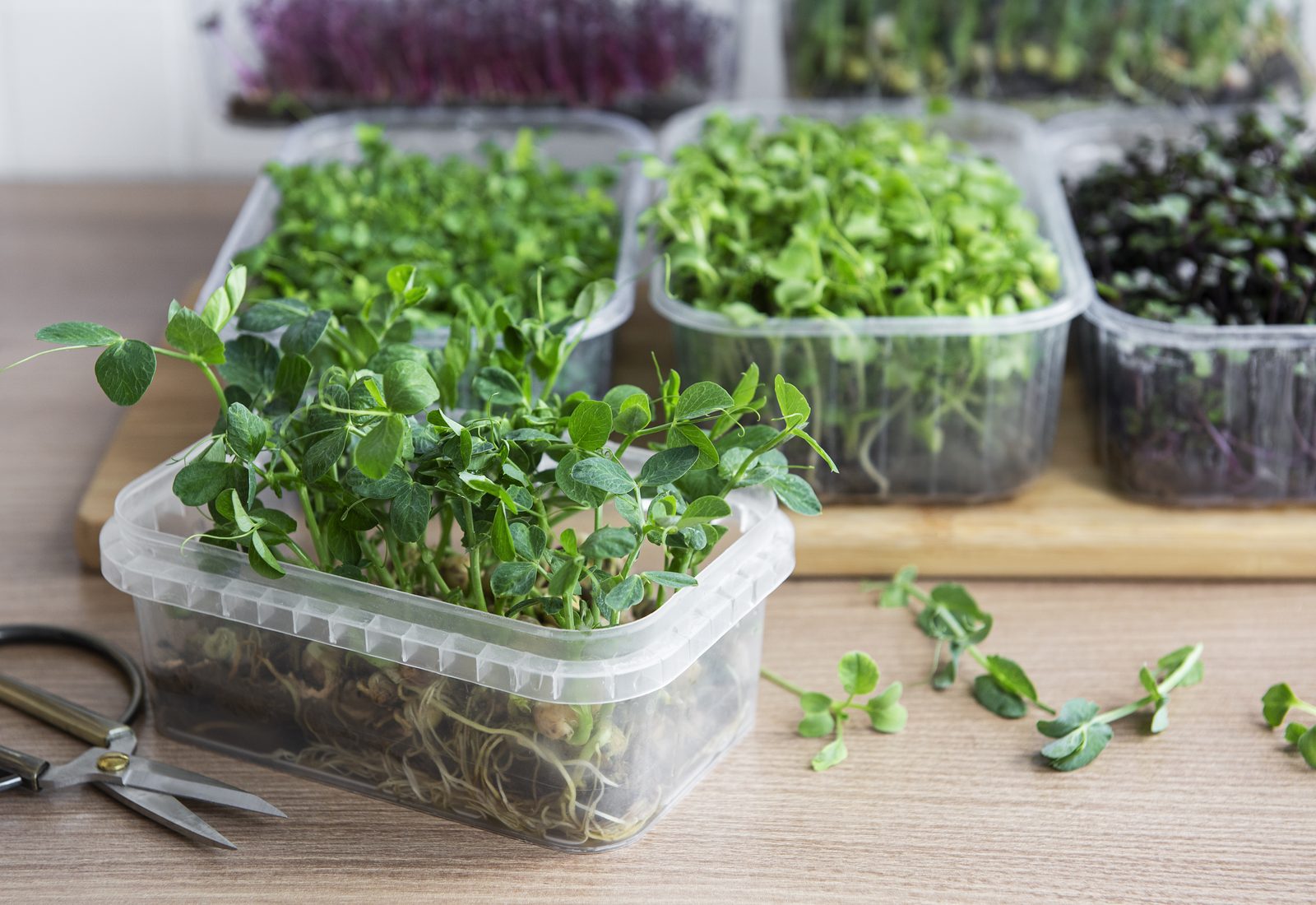
Usually yes. At 5°C (41°F), radish and roselle microgreens kept better in a rigid, perforated PET clamshell than in a perforated self-seal bag (Ghoora & Srividya, 2020). Both packs had holes, so the finding is rigid versus bag, not vented versus sealed.
Sealed is not automatically wrong. The 14 days for mustard came in sealed polyethylene bags (Dayarathna et al., 2023). Radish kept best in a bag with a moderate oxygen transmission rate, ahead of laser-perforated bags (Xiao et al., 2014).
Arugula vacuum-sealed at 5°C (41°F) lost sensory quality from day five. Open packs lost less weight, and modified-atmosphere packs scored best (Komeroski et al., 2024).
On how to store microgreens in a pack, the research favors dry, rigid and loosely packed, with a little air. Poking vents in a repack is a sensible hedge, though no trial tested it.
Skip washing before storage. Rinse at the plate (New Mexico State University, n.d.; Sánchez & Berghage, 2025), and see our washing guide for the method. The FDA says to wash produce under running water before eating, farmers market produce included (U.S. Food and Drug Administration, 2024b).
What fridge temperature keeps microgreens fresh in the US, UK, Canada and Australia?
Aim for 4 to 5°C (40 to 41°F), whichever agency you follow. The FDA says 4°C (40°F) or below (U.S. Food and Drug Administration, 2024a). Health Canada says 4°C (40°F) or lower (Health Canada, 2024).
The UK Food Standards Agency says 0 to 5°C (32 to 41°F) and recommends checking a fridge thermometer once a week (Food Standards Agency, 2017). Food Standards Australia New Zealand says 5°C (41°F) or colder, in text written for food businesses (Food Standards Australia New Zealand, n.d.).
The trials ran at 5°C (41°F), one degree above the FDA ceiling. A fridge that meets the FDA target sits in the range the trials favor. Buckwheat microgreens held at 1, 5 and 10°C (33.8, 41 and 50°F) carried fewer microbes and less tissue damage than at 15 and 20°C (59 and 68°F), and the authors recommend 5°C (41°F) (Kou et al., 2013).
The agencies set their numbers for food safety, and the trials measured freshness. The two line up. How to store microgreens in any of these four countries has a short answer: a shelf away from the door, at 4 to 5°C (40 to 41°F). Set the thermometer on the shelf where the greens sit, and read it there.
How do you store a living tray of microgreens from a grower?
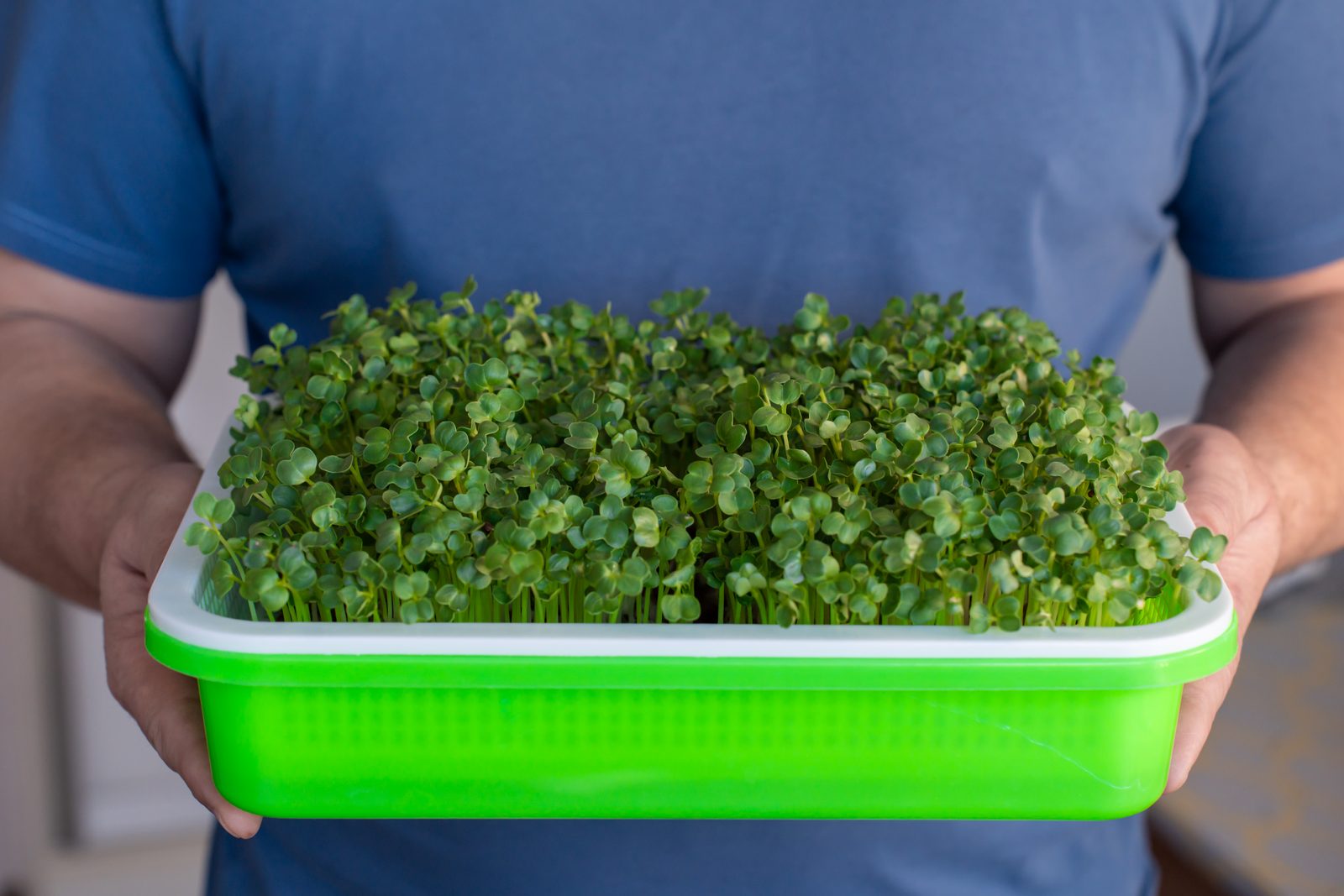
Do not cut it all at once. Penn State lists selling microgreens still growing in seeding trays as one grower option (Sánchez & Berghage, 2025). New Mexico State University advises against cutting microgreens until you are ready to eat them (New Mexico State University, n.d.).
A tray left alone has not started its clock. Crops differ, so ask the grower how long that tray will hold. Cut what the meal needs, just above the soil, with clean scissors, and leave the rest.
Cutting only what you need keeps leftover greens from sitting in the fridge, ticking down. For water and light, follow the grower’s care card. This article gives no care directions of its own.
Once you cut, the clock starts. New Mexico State University says to eat cut greens within 3 to 5 days of harvest (New Mexico State University, n.d.). Treat the cut portion like any store-bought pack: cold, dry and in a rigid box with a little air. That is how to store microgreens you cut yourself.
How do you buy microgreens that stay fresh longer?
The best answer on how to store microgreens starts at the stall: ask when they were cut, and count from that day. New Mexico State University says to eat microgreens no later than 3 to 5 days after harvest (New Mexico State University, n.d.). A harvest date tells you more than a printed shelf life. A good seller can tell you the cut date on the spot.
Look for greens that were not washed before sale. Penn State notes that growers who wash before selling shorten shelf life, so a tidy, rinsed look can hide a shorter life (Sánchez & Berghage, 2025). Check that the display is chilled too. Turner et al. (2020) note that no food-code requirements are specific to microgreens, so a cold case and a harvest date are your best signals.
A grower nearby means less time in transit. The Microgreens 411 directory lists growers by location, and coverage varies by region, so some areas have few listings. Our buying guide covers where to find them.
Wrap-up: how to store microgreens after you buy them
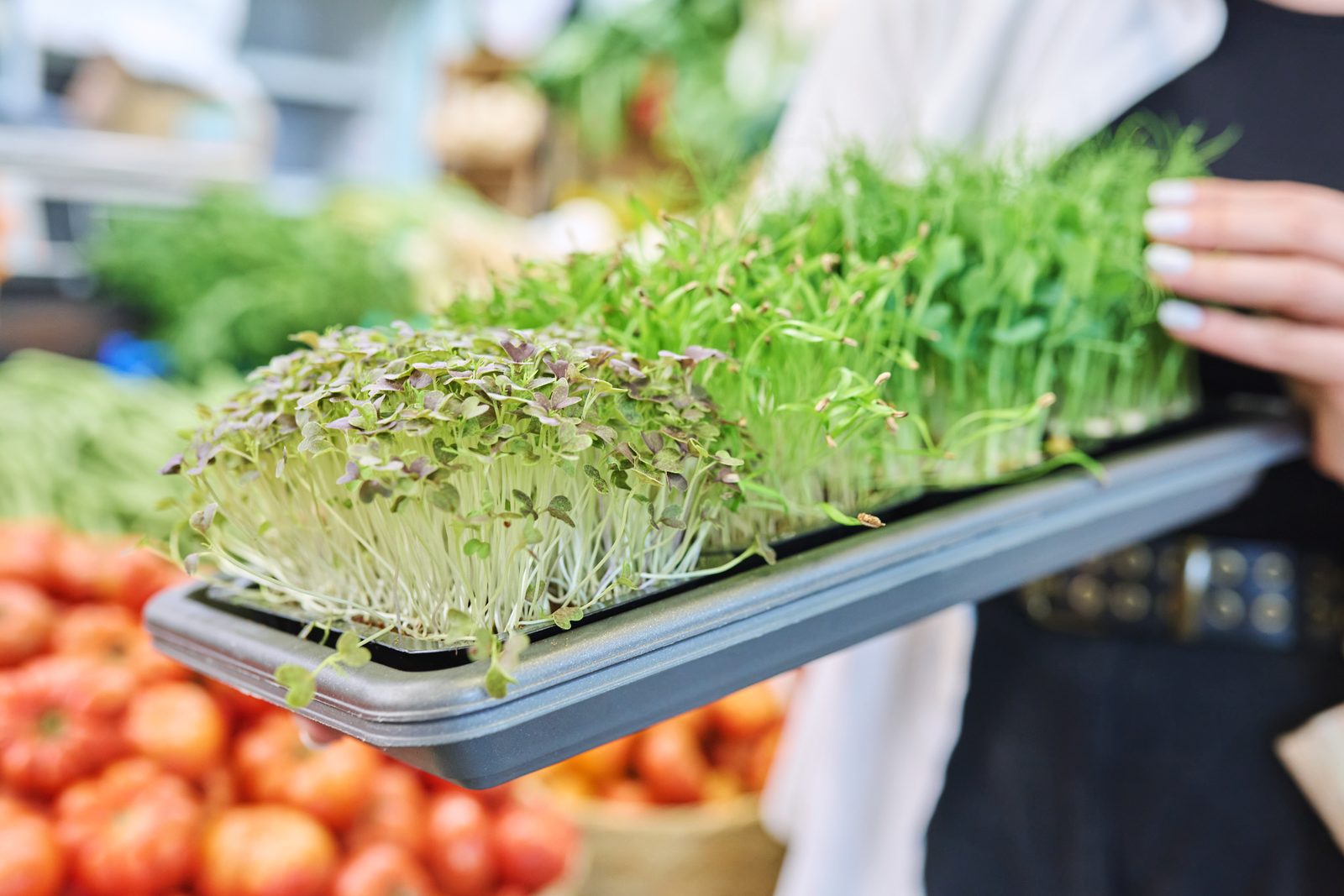
Get them cold within the hour and keep them dry in a rigid pack with a little air. Rinse at the plate, not before. Those moves protect the days you have left, and the harvest date decides how many days that is. My wet, sealed clamshell is the reminder: read the pack, not just the date.
Fresher greens start with a grower closer to home. Finding one is the next piece of a larger picture, and the Microgreens 411 directory is the place to start.
Find a microgreens grower near you
Greens that travel less start fresher in your fridge. Find my local grower →
Frequently asked questions
Should you put a paper towel in the container?
No trial tested one, so nothing shows it helps or hurts. For how to store microgreens with a paper towel, ranking pages disagree, and the research is silent. If you try one, it is your own experiment. Swap it out when it turns damp, and drop it if the greens look worse.
Is the crisper drawer the best place for microgreens?
No microgreen trial tested a crisper drawer, so nothing supports calling it the best spot. General fridge guidance puts fruit and vegetables there (Hohenstein, 2026). Treat it as a reasonable choice, not a proven one.
Can you store microgreens in water like fresh herbs?
No tested method exists. Cut greens have no roots to take up water, and none of the sources we used describe a glass of water as a storage method (New Mexico State University, n.d.; Sánchez & Berghage, 2025).
Is it safe to eat microgreens after the date on the pack?
The date marks quality, not safety. The USDA Food Safety and Inspection Service says dates on food, apart from infant formula, are not safety indicators and are not required by federal law (U.S. Department of Agriculture, Food Safety and Inspection Service, n.d.). Judge by condition, and skip any greens that look or smell off. Our spoilage signs guide shows what to look for.
Can you store microgreens long term?
Not well. For how to store microgreens past a couple of weeks, we found no published trial of home-freezing fresh microgreens. Hot-air drying of radish microgreens cut vitamin C by up to 63 percent, and some B vitamins held (Jauregui et al., 2025).
Can you store microgreens the way you store sprouts?
Do not assume so. Microgreens are cut at the soil line. Sprouts are grown in water and eaten whole (Turner et al., 2020). Every storage figure in this article comes from microgreen sources, not sprout guidance.
References
Dayarathna, N. N., Gama-Arachchige, N. S., Damunupola, J. W., Xiao, Z., Gamage, A., Merah, O., & Madhujith, T. (2023). Effect of storage temperature on storage life and sensory attributes of packaged mustard microgreens. Life, 13(2), 393. https://doi.org/10.3390/life13020393
Food Standards Agency. (2017, December 18). How to chill, freeze and defrost food safely. GOV.UK. https://www.gov.uk/government/publications/how-to-chill-freeze-and-defrost-food-safely/how-to-chill-freeze-and-defrost-food-safely
Food Standards Australia New Zealand. (n.d.). Keeping food at the right temperature. https://www.foodstandards.gov.au/business/food-safety/keeping-food-at-the-right-temperature
Ghoora, M. D., & Srividya, N. (2020). Effect of packaging and coating technique on postharvest quality and shelf life of Raphanus sativus L. and Hibiscus sabdariffa L. microgreens. Foods, 9(5), 653. https://doi.org/10.3390/foods9050653
Health Canada. (2024, April 11). Safe food storage. https://www.canada.ca/en/health-canada/services/general-food-safety-tips/safe-food-storage.html
Hohenstein, C. (2026, January 28). Refrigerator safety and organization. NC State Extension, Buncombe County. https://buncombe.ces.ncsu.edu/news/refrigerator-safety-and-organization/
Jauregui, M. J., Warren, E. R., Di Gioia, F., Kwasniewski, M. T., & Lambert, J. D. (2025). Effects of hot air drying on the nutritional and phytochemical composition of radish (Raphanus sativus L.) microgreens. Journal of Food Science, 90(7), e70426. https://doi.org/10.1111/1750-3841.70426
Komeroski, M. R., Beninca, T., Portal, K. A., Malheiros, P. S., Klug, T. V., Flores, S. H., & Rios, A. O. (2024). Postharvest quality of arugula (Eruca sativa) microgreens determined by microbiological, physico-chemical, and sensory parameters. Foods, 13(19), 3020. https://doi.org/10.3390/foods13193020
Kou, L., Luo, Y., Yang, T., Xiao, Z., Turner, E. R., Lester, G. E., Wang, Q., & Camp, M. J. (2013). Postharvest biology, quality and shelf life of buckwheat microgreens. LWT – Food Science and Technology, 51(1), 73–78. https://doi.org/10.1016/j.lwt.2012.11.017
New Mexico State University. (n.d.). Eating microgreens. All About Microgreens. https://all-about-microgreens-d.nmsu.edu/consumers.html
Sánchez, E., & Berghage, R. (2025, December 16). Growing microgreens. Penn State Extension. https://extension.psu.edu/growing-microgreens
Turner, E. R., Luo, Y., & Buchanan, R. L. (2020). Microgreen nutrition, food safety, and shelf life: A review. Journal of Food Science, 85(4), 870–882. https://doi.org/10.1111/1750-3841.15049
U.S. Department of Agriculture, Food Safety and Inspection Service. (n.d.). Food product dating. https://www.fsis.usda.gov/food-safety/safe-food-handling-and-preparation/food-safety-basics/food-product-dating
U.S. Food and Drug Administration. (2024a, March 5). Refrigerator thermometers: Cold facts about food safety. https://www.fda.gov/food/buy-store-serve-safe-food/refrigerator-thermometers-cold-facts-about-food-safety
U.S. Food and Drug Administration. (2024b, March 5). Selecting and serving produce safely. https://www.fda.gov/food/buy-store-serve-safe-food/selecting-and-serving-produce-safely
Xiao, Z., Lester, G. E., Luo, Y., Xie, Z., Yu, L., & Wang, Q. (2014). Effect of light exposure on sensorial quality, concentrations of bioactive compounds and antioxidant capacity of radish microgreens during low temperature storage. Food Chemistry, 151, 472–479. https://doi.org/10.1016/j.foodchem.2013.11.086